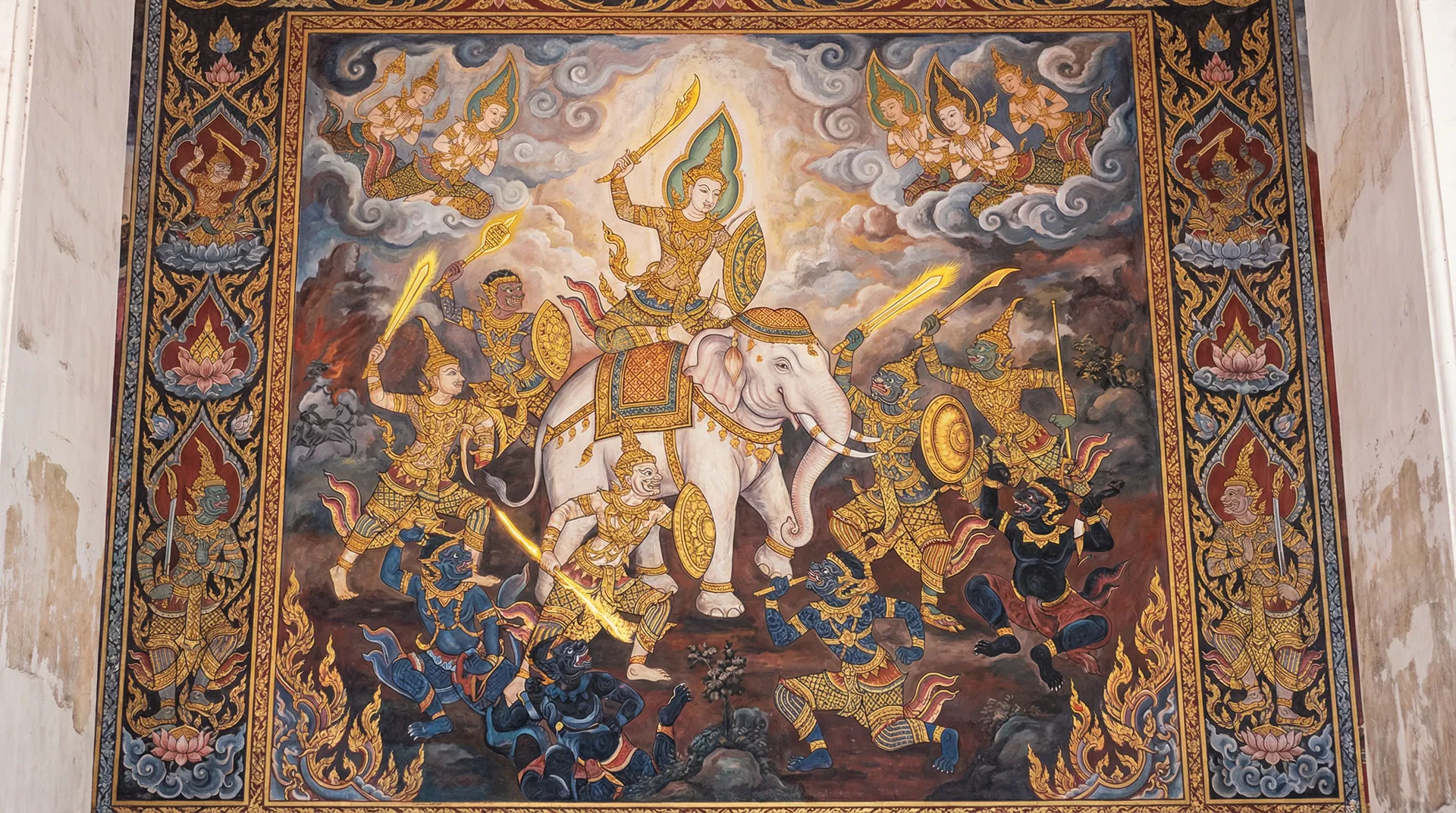
Ghata Jataka
Ghata Jataka
In a time long past, when the Bodhisatta was born as a wise and exceptionally strong potter, the kingdom of Kasi was a bustling hub of commerce and craft. The potter, whose name was Ghata, lived in a humble dwelling on the outskirts of the city, his days filled with the rhythmic thud of clay being shaped on his wheel and the smoky aroma of his kiln. Ghata was not just any potter; he possessed a strength that defied his appearance. His hands, though calloused from years of working with earth, could wield tools with superhuman precision, and his grip was legendary among the villagers. He was known for his honesty and his unwavering commitment to producing the finest pottery, from delicate bowls to sturdy water jars.
One day, a renowned merchant, known for his vast wealth and his insatiable desire for unique treasures, arrived in the city. He had heard tales of Ghata’s exceptional skill and sought him out. The merchant, a man of flamboyant dress and an even more flamboyant ego, stood before Ghata’s stall, his eyes scanning the array of beautifully crafted earthenware. He pointed to a particularly elegant vase, its glaze shimmering like a dragonfly’s wing.
“Potter,” the merchant declared, his voice laced with an air of superiority, “I desire this vase. But I will not pay your usual price. I am a patron of the arts, and I believe my patronage alone is worth more than mere coin.”
Ghata, a man of quiet dignity, looked at the merchant without flinching. “Sir,” he replied calmly, “this vase is the result of much labor and skill. Its price reflects its quality. If you wish to purchase it, you must pay the agreed-upon price.”
The merchant scoffed. “You dare to bargain with me? I am a man of influence! My word can make or break you. I will give you a paltry sum, and you will be grateful for my generosity.” He offered a sum that was insultingly low.
Ghata, though tempted to refuse outright, understood that sometimes, the greatest strength lies in restraint. He decided to teach the merchant a lesson, not through anger, but through a demonstration of his own capabilities. “Very well, sir,” Ghata said, a subtle glint in his eye. “You deem yourself a man of great strength and influence. I, too, possess a certain strength, though it is of a different kind. If you can demonstrate a feat of strength that surpasses mine, I will gladly give you this vase and a hundred more. But if you fail, you will pay double the price for this single vase and promise never again to insult the craft of honest artisans.”
The merchant, blinded by his arrogance, readily agreed, convinced of his own superiority. A crowd of onlookers gathered, drawn by the unusual challenge. The merchant, puffing out his chest, began by trying to lift a massive stone that lay in the marketplace, a feat he had boasted of many times. He strained and grunted, his face turning red, but the stone barely budged. He then attempted to bend an iron bar, but his efforts were futile.
Ghata watched patiently. When the merchant, sweating and humiliated, finally conceded defeat, Ghata approached the stone. With a calm, steady effort, he wrapped his powerful arms around it. He braced himself, and with a deep breath and a controlled exertion of his immense strength, he lifted the stone high above his head, holding it there for a full minute before gently setting it down. The crowd gasped in awe.
Next, Ghata picked up a similar iron bar. With a focused intensity, he bent it into a perfect circle, the metal groaning under his controlled power. The onlookers erupted in cheers, marveling at the potter’s incredible strength.
The merchant, utterly humbled and ashamed, stammered, “I… I have been mistaken. Your strength is indeed far beyond mine. I apologize for my arrogance and my disrespect. I will pay double the price for the vase and will always remember this lesson.”
Ghata, his face serene, accepted the payment. He then presented the vase to the merchant, saying, “Take this, and remember that true strength is not found in boastfulness or coercion, but in quiet power, skill, and integrity. It is the strength of diligence, the strength of honest work, and the strength of character.”
From that day on, the merchant was a changed man. He treated artisans with respect, recognizing the value of their craft and the hidden strengths they possessed. He often spoke of the humble potter Ghata, whose quiet display of power had taught him a lesson more valuable than any treasure. Ghata continued his work, his reputation for strength and integrity spreading far and wide, a testament to the fact that true power lies not in outward show, but in inner fortitude and the mastery of one’s craft.
— In-Article Ad —
💡Moral of the Story
True strength is not measured by outward displays of force or arrogance, but by inner fortitude, skill, integrity, and the quiet power of diligence and honest work.
Perfection: Diligence (Viriya), Truthfulness (Sacca)
— Ad Space (728x90) —
More Jataka Tales You May Enjoy
 18Ekanipāta
The Bodhisatta as a King of Deer
The Bodhisatta as a King of DeerIn the heart of a vast and ancient forest, where sunlight dappled th...
💡 True leadership and love manifest in selfless sacrifice, inspiring even the hardest hearts.
 252Tikanipāta
Muni-Jātaka
Muni-JātakaIn the ancient land of Mithila, where wisdom was revered and philosophers debated the nat...
💡 True wisdom is not achieved by mere abstinence from speech, but by mindful communication and the cultivation of inner peace. Words, when used with truth, compassion, and clarity, are powerful tools for good, not inherently the cause of suffering.
 462Ekādasanipāta
Chaddanta Jātaka
Chaddanta JātakaDeep within the mystical Himalayas, where snow-capped peaks kissed the azure sky and...
💡 True compassion and selflessness involve sacrificing even one's most cherished possessions or physical attributes for the well-being of others, especially those who have wronged us. Jealousy and envy lead to suffering and regret.
 426Aṭṭhakanipāta
Mugapakkha Jataka
The Tale of the Muzzled Ox In the ancient city of Mithila, nestled amidst lush gardens and bustling ...
💡 True salvation comes not from superstitious rituals or sacrifices, but from cultivating wisdom, compassion, and living in harmony with the natural world. Our actions, our understanding, and our respect for life are what truly bring about prosperity and balance.
 469Dvādasanipāta
Temiya Jataka
Temiya JatakaIn the opulent city of Ujjeni, reigned King Kalabu, a monarch whose heart was as cold a...
💡 True spiritual understanding leads to detachment from worldly pursuits, and true liberation comes from mastering the mind.
421AṭṭhakanipātaMūgapakkha Jātaka
Mūgapakkha JātakaIn the heart of the Kosala kingdom, where golden fields stretched to the horizon an...
💡 True strength lies not in the ability to speak or exert force, but in the power of selfless compassion and unwavering sacrifice. Actions, especially those born of immense kindness, speak louder than words.
— Multiplex Ad —